Heritage · 2026
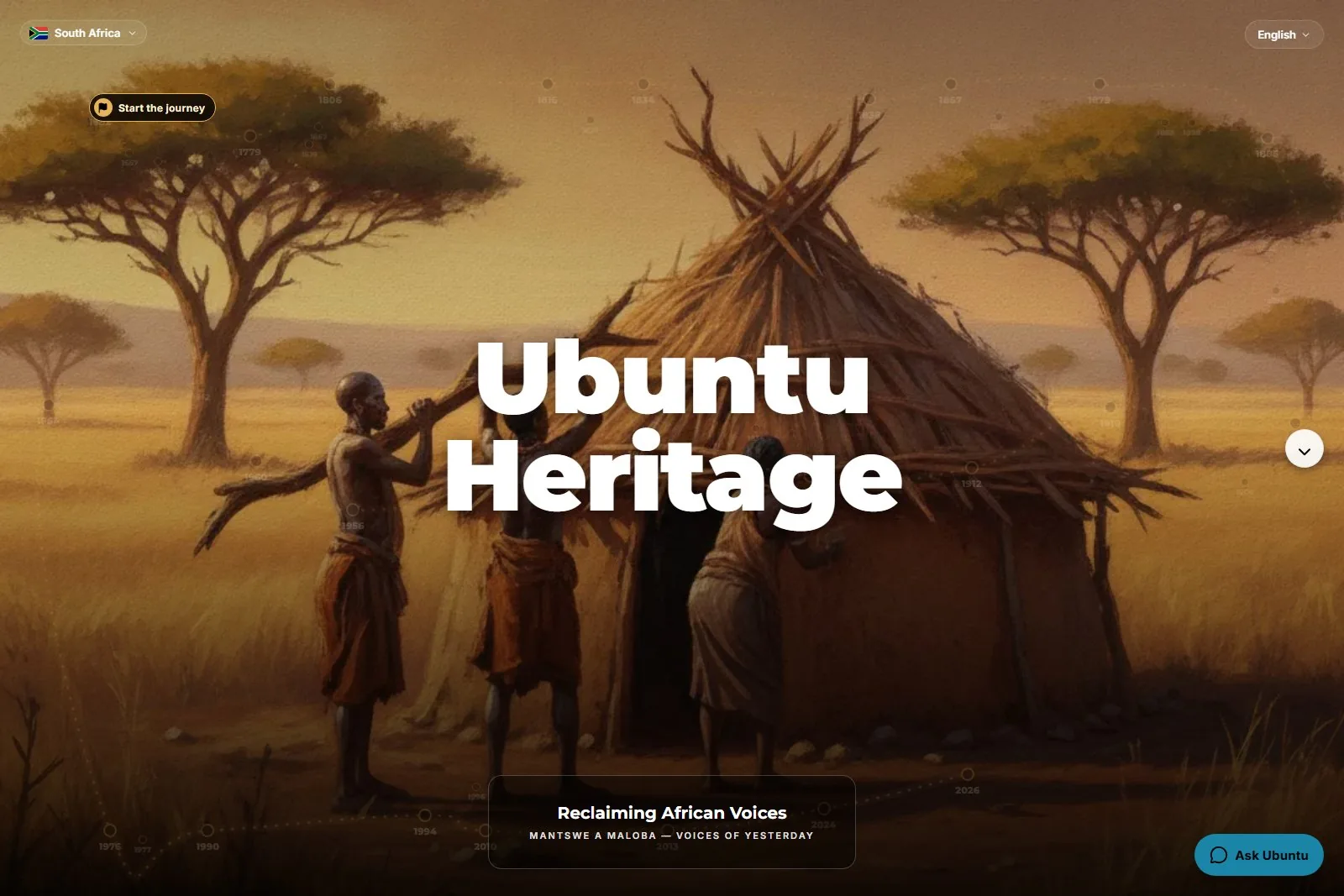
Ubuntu Heritage — the canon, made cinematic
An offline-first app that turns four foundational South African texts into cinematic, multilingual scenes — and hands the archive back to the communities the stories came from.
- Client
- Tumo Olo — our own product, built for a UNISA hackathon
- Outcome
- Four foundational texts, playable on a cheap phone
- Work in this line
- Websites
- Started
The problem
South Africa’s foundational indigenous literature reaches most people as a set-work summary, or not at all. What is online about the heritage around it is thin, uncited, or taken from communities without their say. And a reader on an inexpensive Android phone with poor signal is not served by any of it.
The approach
One Expo app for web, Android and iOS, humanities first. Four texts — Plaatje’s Mhudi, Mqhayi’s Ityala Lamawele, Mutwa’s Indaba, My Children and Vilakazi’s Inkondlo kaZulu — rendered as cinematic scenes in both a child and an adult mode, in more than one language. Around them a cultural atlas where every claim carries its source, and a walkable journey through the history. A POPIA-compliant community archive lets elders record their own stories, own them, and erase them. The public-domain canon is notarised on-chain by hash and citation only, never anyone’s personal data. Where a fact is not sourced it is marked rather than invented, and every AI-generated image or machine translation says that it is one.
Where it stands
The four pillars, the atlas and the journey are built and running. Some integrations are wired but stay dormant until an API key is added, and the app says which rather than failing quietly. It is designed to cost nothing to keep alive and to work on a cheap Android phone with bad connectivity. A build is up at mogame.tumoolo.tech while the community archive and the ledger are finished.